How Technology Will Change the Way We Digitise Existing Buildings

Kseniya Kutsenko
06.02.2026
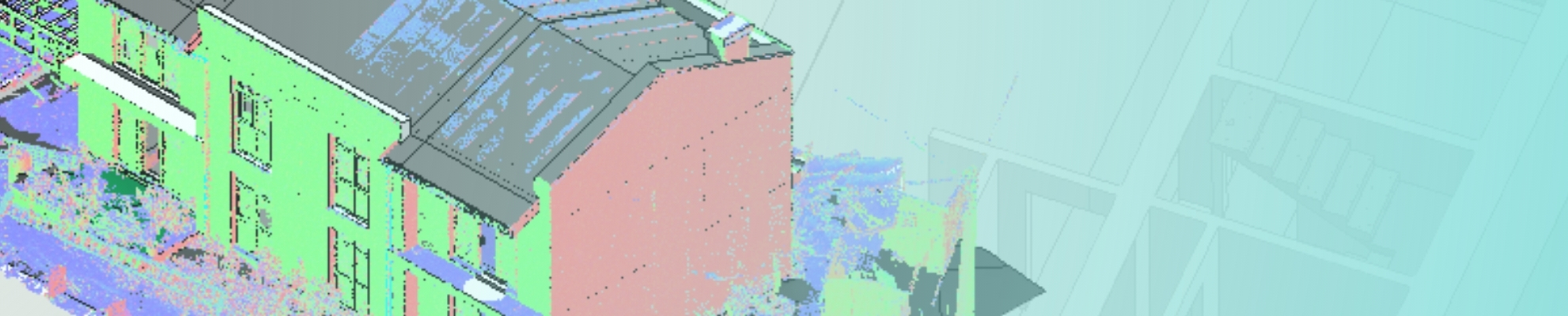
Digitising existing buildings using BIMPROVE (Scan to BIM) is the process of converting reality-capture data (laser scans, LiDAR, photogrammetry) into precise BIM models in LOD 100–350, using software such as Autodesk Revit. It is used to create reliable digital building data for renovation, facility management, and structural analysis in projects across the USA, Europe, Australia, and the UK.
Many existing buildings predate modern digital standards. Because of that, project teams often work with outdated documentation, incomplete drawings, or no reliable records at all.
Scan to BIM technologies address this by transforming physical buildings into structured digital models that architects, engineers, contractors, and facility managers can use.
How we digitise buildings nowadays
The traditional method of capturing the conditions of an existing building meant sending survey teams to measure spaces and structural elements manually.
The process was time-consuming, and errors often occurred.
Within today's AEC field, Scan to BIM is employed to digitise existing buildings. Stakeholders use scanning methods that include:
-
Laser scanning (LiDAR)
-
Drone-based scanning
-
Photogrammetry
-
Mobile and handheld scanners
As outputs, you can receive:
-
Parametric BIM models (Revit)
-
2D documentation
-
Coordinated building data
At BIMPROVE, if you receive our Scan to BIM services, you work with a department of 21 Scan to BIM specialists. BIMPROVE has completed more than 2,000 projects across many building types for the US, UK, Australian, and European markets.
Challenges and limitations of Scan to BIM
Just like any developing technology, Scan to BIM has its issues. They include:
Busy environments
Scanning the environment works best in empty areas. If it is not possible to free the space entirely, it becomes a challenge.
Weather conditions
Outdoor scanning cannot be performed in unfavourable weather conditions, such as rain or snow.
Complex and large areas
Scanning hard-to-access areas is challenging, and so is working with large territories. It requires powerful computers and large storage capacities.
The future of building digitisation
Modern Scan to BIM trends include digital twins, AI, machine learning, automation, VR, and AR.
The Rise of Digital Twins
A digital twin is a virtual representation of a physical building that integrates geometry, system data, and operational information. It differs from traditional models by simulating building performance and updating continuously with real-world data.
Digital twins are created by combining 3D models with sensors, IoT devices, and monitoring systems. These technologies let building operators track:
-
environmental conditions
-
structural movement
-
energy usage
-
equipment performance in real time
For existing buildings, digital twins offer the following benefits:
-
monitoring building condition
-
predict maintenance needs
-
simulate upgrades before actually implementing them
For structural engineers, digital twins can help detect deformation, settlement, or structural changes by comparing scan data from different time points.
This approach is increasingly adopted in projects across the USA and Europe.
Integration With Facility Management
BIM models filled with asset data, system specifications, and maintenance history can support long-term building operations.
Modern workflows include:
-
Linking BIM models with FM platforms
-
Storing asset and maintenance data
-
Tracking lifecycle performance
Benefits include the following:
-
Continuous data updates
-
Centralised building information
-
Improved operational decision-making
Automation and AI in Scan to BIM workflows
One of the most time-consuming steps in Scan to BIM is converting point cloud data into usable models.
The traditional Scan to BIM process involves importing point cloud data into modelling software and manually reconstructing building elements such as:
-
walls
-
columns
-
beams
-
mechanical systems
Artificial intelligence is transforming this process.
Advanced algorithms now can:
-
detect architectural and structural elements directly from point cloud data
-
identify walls, slabs, openings, and rooms automatically
-
convert large point clouds into BIM models compliant with industry standards such as IFC
Going forward, AI-powered modelling tools are expected to greatly cut down the time needed to create precise BIM models. In future workflows, engineers will focus on validation and coordination rather than manual modelling.
FAQ
How does Scan to BIM compare to traditional methods?
Compared to traditional surveying, Scan to BIM provides significant advantages, such as saving 28% on time and costs, boosting accuracy, and cutting errors by 40%.
What are the main benefits of Scan to BIM?
The benefits of Scan to BIM include:
-
less on-site work and disruption
-
fewer instances of rework
-
better visualisation and analysis of the building's structure
Stakeholders can also use 3D BIM models to spot issues and conflicts early, which leads to better decision-making and problem-solving.
Can a Scan to BIM modelling team join at different stages of a project?
BIMPROVE is ready to collaborate at any stage of your project in the markets of the US, the UK, Australia and Europe, offering services such as:
-
laser scanning
-
scan registration
-
noise filtering
-
point cloud export
-
BIM modelling
-
2D drawing extraction
Conclusion
Digitising existing buildings is transitioning from manual surveys to automated, data-driven workflows.
Nowadays, Scan to BIM enables accurate and structured digital representations of buildings. Soon, AI, digital twins, and automation will further transform building capture, modelling, and management.
As these technologies develop, building digitisation will become:
-
Faster
-
More automated
-
More scalable
The expected result is a future in which every building—new or old—has a precise, continuously updated digital counterpart.
To help you with your project, BIMPROVE’s Scan to BIM department offers services to convert raw scan data into reliable models and drawings across the UK, the US, Australia, and Europe.
Share:




SOCIAL MEDIA







© Copyright BIMPROVE company LLC. All rights reserved 2026. Privacy Policy.