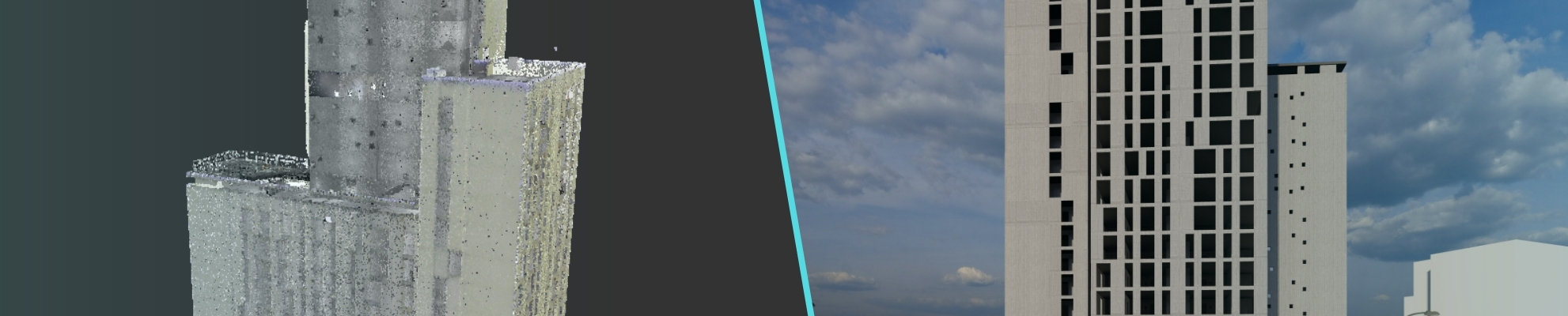
How Scan to BIM Services Revolutionise Renovation and Heritage Projects

Kseniya Kutsenko
05.27.2026
Scan to BIM is the process of converting 3D laser-scanning data and point clouds into accurate BIM models in software such as Autodesk Revit. The service is used for renovation, restoration, retrofit, and heritage preservation projects. BIMPROVE delivers Scan to BIM models from LOD 100 to LOD 350 for Architectural, Structural, Site, MEP, and Fire Protection disciplines across the USA, the UK, Australia, and Europe.
Cultural heritage is a valuable asset that reflects the history, architecture, and culture of a region.
For existing and historical buildings, accurate digital documentation is a great benefit. Many heritage projects lack reliable drawings, contain irregular geometry, or include hidden structural and MEP systems. Scan to BIM helps project teams create accurate digital models before renovation work begins.
Issues with renovation and heritage projects
Heritage projects face issues such as inaccurate drawings, maintaining the building's authenticity, and dealing with geometric complexity.
Inaccurate 2D plans
Old plans are often faded, lack detail, or simply are not true to life. Problems can arise at every step of the way without an accurate plan that describes:
-
MEP
-
pipe systems
-
the state of walls
-
hardly accessible areas of the object
This creates risks during renovation because contractors may discover undocumented systems, structural changes, or geometry conflicts during construction.
Building authenticity
Companies need to ensure construction is safe and stable while maintaining the look, character, and details. Renovation teams must:
-
Maintain the building’s original appearance
-
Preserve architectural details
-
Improve structural safety
-
Upgrade MEP systems
-
Meet modern building standards
Geometric complexity
Historic buildings rarely follow modern construction standards. Teams often encounter:
-
Uneven walls
-
Non-standard dimensions
-
Irregular ceilings
-
Curved surfaces
-
Decorative architectural elements
BIMPROVE can recreate complex equipment, structures, and building geometry from point clouds with an accuracy of ±5 mm.
Benefits of using Scan to BIM in renovation
Scan to BIM in renovation can improve accuracy, save time and resources, facility management, and accurately preserve history.
Accuracy
Laser scanning captures millions of measurement points from the building environment. This creates a reliable digital reference for architects, engineers, and contractors.
Benefits include:
-
Reduced measurement errors
-
Better coordination between disciplines
-
Fewer on-site surprises
-
Lower rework risk
BIMPROVE reports that Scan to BIM workflows can reduce project errors by up to 40%.
Saving time and resources
Traditional surveys of large or complex buildings can take days or weeks. Laser scanning significantly reduces site measurement time.
This is especially useful for:
-
Occupied buildings
-
Industrial facilities
-
Multi-story structures
-
Heritage sites with limited access
The collected point cloud data can then be used simultaneously by multiple teams working on architectural, structural, and MEP models.
Facility management
The BIM model remains useful after the renovation is complete. Building owners can use the model for:
-
Facility management
-
Future renovations
-
Asset tracking
-
Maintenance planning
-
MEP system upgrades
History preservation
Historical buildings and renovation projects benefit from the Scan to BIM technology. A digital model of an old building increases respect for the original building and its history. Their heritage is well-conserved, and no value is lost.
Historic Building Information Modelling
Historic Building Information Modelling (HBIM) helps us handle heritage projects with respect and accuracy. As it was mentioned before, old buildings usually require additional effort, and they can be harder to deal with if you don’t have proper technologies.
There is a clear, uncomfortable balance in these projects: the need to provide proper renovations for safety and stability, and the necessity to keep historical accuracy and value of the building. BIMPROVE with Scan to BIM services can carry out various projects in LOD100-350 in the USA, the UK, Australia and Europe. There are several major challenges we are dealing with:
-
Making sure the techniques aren’t harsh on the old materials
-
Handling complex and irregular geometries
-
Ensuring accurate data using Scan to BIM and other modern technologies
With every step in the project, there may be risks, but Scan to BIM can make the process easier, safer, and more efficient.
Conclusion
The development of Scan to BIM has changed the renovation process across all types of projects. Using this technology, renovation becomes faster and achieves quality and accuracy that were previously unattainable. The technology facilitates well-informed decision-making in all stages of planning and development.
Give your object a new life and ensure it will be a stable, steady, and safe process! Book a consultation with BIMPROVE to learn more about your possibilities and leave your worries to us.
FAQ
What is Scan to BIM?
Scan to BIM is the process of converting laser-scanning data and point clouds into BIM models using software such as Autodesk Revit.
What LOD does BIMPROVE provide?
BIMPROVE delivers Scan to BIM models from LOD 100 to LOD 350.
What types of buildings can be modelled?
BIMPROVE works with:
-
Residential buildings
-
Educational buildings
-
Industrial facilities
-
Historical buildings
-
Commercial buildings
-
Institutional projects
-
Bridges
-
Roads
-
Storage facilities
Which software is used for Scan to BIM?
BIMPROVE uses BIM software such as Autodesk Revit for Point Cloud to BIM modelling workflows.
What accuracy can be achieved in Scan to BIM projects?
BIMPROVE can recreate complex geometry and equipment from point clouds with an accuracy of ±5 mm.
Is Scan to BIM useful for heritage projects?
Yes. Scan to BIM and HBIM workflows are widely used for the restoration, renovation, and preservation of historical buildings.
Share:





SOCIAL MEDIA







© Copyright BIMPROVE company LLC. All rights reserved 2026. Privacy Policy.