British Standards for Fire Protection

Denys Moshenskyi
06.03.25
Introduction
Imagine you are responsible for designing or upgrading a building’s fire protection system and need to ensure full compliance with British Standards. Which documents do you choose, given there are so many? How does a sprinkler system standard differ from one that governs fire alarms? In this article, we will explore the most in-demand British standards for fire protection systems and examine why they are crucial to follow.
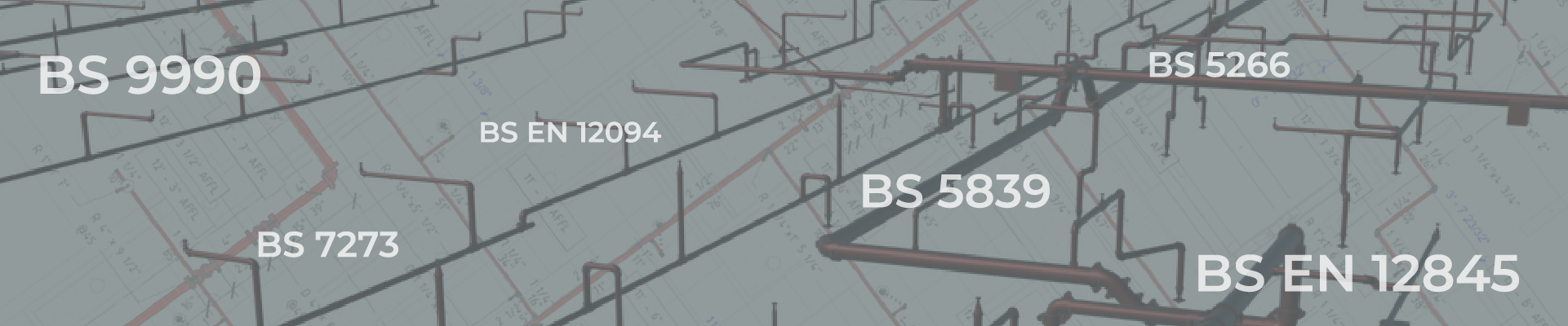
We will focus on BS 9990, BS EN 12845, and other regulations covering various aspects of fire safety—from hydrant installation to alarm systems. By the end of this article, you will have a clearer idea of where to begin and how to proceed so that your fire protection system meets internationally recognised levels of reliability and safety.
1. What Are the British Fire Protection Standards?
British Standards (BS) are official documents developed and published by the British Standards Institution (BSI). They provide minimum requirements for equipment or systems' quality, design, installation, and operation. When it comes to fire protection, British Standards help:
-
Avoid inaccuracies in design and installation.
-
Simplify collaboration among project stakeholders (clients, contractors, supervisory bodies).
-
Reduce the risk of equipment failures, malfunctions, or improper operation.
By following British Standards, you can be confident that your fire safety system is formally “in order” and genuinely protects people and property.
2. Key Standards: Which Documents Should You Consider?
Below are the most prominent British Standards for the design of fire protection systems. Each document focuses on a specific aspect of safety, from sprinklers to fire hydrants.
2.1 BS 9990: Dry Riser Systems and Water Supplies
BS 9990 is the key standard governing Dry Riser systems, which are vertical pipework that remains uncharged with water until a fire occurs. In an emergency, fire hoses are connected, allowing water to be delivered directly to the area in need of firefighting.
Key points:
-
Design and Placement
-
Optimal positioning of risers and outlets for fire brigade access.
-
Minimum pipe diameter (commonly DN 100) and materials that prevent leaks or deformation.
-
Pressure and Flow
-
Adequate pressure and flow must be maintained to extinguish fires effectively on the required floor level.
-
Calculating the load on pumps or hydrants is typically required.
-
Maintenance and Inspections
-
Regular checks for pipe and valve integrity, plus periodic flow testing—often quarterly or every six months.
-
Prompt removal of any sediment that may accumulate within the risers.
Why It Matters: A Dry Riser system saves time when tackling fires in multi-storey buildings, offering a swift, centralised water supply inside the property. Compliance with BS 9990 ensures that this arrangement remains both reliable and safe.
2.2 BS EN 12845: Sprinkler Fire Protection Systems
Regarding sprinkler systems, BS EN 12845 is the go-to standard. It provides clear guidelines for designing and installing fixed sprinkler systems that activate automatically when temperatures rise or smoke is detected. Among other things, it covers:
-
Classification of buildings by fire risk: Each risk level dictates its requirements for sprinkler density and component specifications.
-
Pump and reservoir requirements: How much water must be stored and the pressure at which it must be supplied.
-
Sprinkler head positioning: The intervals between heads and the minimum distances from walls and ceilings.
-
Automation and alarms: How the system should interface with control panels and fire alert systems.
Fun fact: Sprinkler systems are often associated with large shopping centres, but they’re increasingly installed in offices and residential complexes due to the uniform requirements set out in BS EN 12845.
2.3 BS 5839: Fire Detection and Fire Alarm Systems
Since BS EN 12845 focuses on active fire suppression, BS 5839 deals with designing and installing fire detection and alarm systems. This standard addresses:
-
System types (automatic, manual, or combined).
-
Detector and alarm placement: Ensuring that smoke and heat detectors pick up fires quickly and that alarms are audible throughout the building.
-
Cabling and power supply: How to guarantee uninterrupted alarm system operation, even during a mains failure.
-
Periodic testing: Procedures for checking detectors and central control panels.
Why is this important? Prompt fire alarm activation is vital for swift evacuation and reducing the risk to human life.
2.4 Other Relevant Standards: What Else Might You Need?
In addition to the documents mentioned above, a comprehensive fire protection approach may involve:
-
BS 5266 – covers emergency lighting and escape lighting.
-
BS 7273 – regulates the operation of automatic doors and access control systems during a fire.
-
BS EN 12094 – a series concerned with gaseous fire-fighting systems (for premises where water may damage equipment, for instance).
Each of these standards owns its “piece of the puzzle” in the broader scope of fire safety. The more precisely you follow these requirements, the more likely your system will function reliable when it matters most.
3. Why Is Compliance with British Standards So Important?
3.1 Safety and Reputation
The main aim is to protect human life and health. British Standards are widely acknowledged as some of the world’s most robust and carefully developed. When your fire protection system is designed according to these requirements, clients and regulatory authorities view you as a reliable and responsible partner.
3.2 Minimising Risks and Costs
Mistakes in a fire protection system can be extremely expensive:
-
Redesigns (extra expenses for replacing pipes, pumps, and detectors).
-
Regulatory fines (if inspections reveal non-compliance).
-
Risk of fire outbreak and potential casualties (the most severe consequence).
3.3 International Consistency
Many global companies and developers rely on British or similar European standards. Complying with them simplifies cooperation on the international stage, from sharing skilled professionals to sourcing equipment.
4. Practical Tips for Implementation
4.1 Begin with Risk Classification
Determine which risk group your premises fall under (low, medium, or high). This classification influences your choice of sprinkler heads, alarm configurations, and pump requirements. For instance, BS EN 12845 recommends higher sprinkler density and a larger water reserve for high-risk buildings.
4.2 Review Local Regulations
Although British Standards are recognised worldwide, remember that each country has its own rules. Some jurisdictions strictly follow BS EN 12845, while others add requirements shaped by regional climate or specific local contexts.
4.3 Engage Certified Professionals
Designing and installing fire protection systems is an area where expertise is critical. It’s better to invest time in finding specialists familiar with British Standards than to pay more later fixing mistakes.
If you need Fire Protection system modelling in Revit or technical drawing support, we can assist at every stage - from evaluating initial data to delivering final detailed designs.
4.4 Check Equipment and Materials
Pumps, piping, and sprinkler heads must have certifications confirming compliance with BS EN 12845 or other relevant standards (e.g., Kitemark). The same goes for fire detectors that meet BS 5839.
4.5 Schedule Regular Inspections
Once installed, the system should undergo routine tests. Standards such as BS 9990 or BS 5839 describe the necessary inspections. Frequent testing helps detect problems early and ensures uninterrupted operation.
5. Frequently Asked Questions (FAQ)
Do I need to follow all standards at once?
Answer: This depends on the nature of the building and its systems. If you only have sprinklers, BS EN 12845 might be sufficient. However, if your facility includes multiple systems (hydrants, fire alarms, emergency lighting), you’ll need to refer to a broader range of standards.
What’s the difference between BS and EN?
Answer: BS stands for British Standards, while EN refers to European Standards. Many of them today are often spelled as “BS EN” (e.g., BS EN 12845). This indicates recognition at both national and pan-European levels.
Can I use American NFPA standards instead of British ones?
Answer: In some countries, yes. However, if you operate in a jurisdiction that specifically mandates BS compliance, it’s more logical to follow British Standards. Otherwise, local supervisory authorities may raise issues.
Where can I find the full texts of these standards?
Answer: They are typically available for purchase from the British Standards Institution (BSI) website or authorised distributors. Some companies also have subscriptions to standards databases.
Conclusion
British standards such as BS 9990, BS EN 12845, and BS 5839 are not merely formal documents but practical guidelines to help you design a truly dependable fire protection system. Compliance with these norms is essential for safeguarding lives, preserving property, and maintaining a strong corporate reputation. If you plan to install or upgrade a fire protection system, invest time in studying the relevant standards and bring in certified experts from the beginning.
Would you like your fire protection system to meet all British Standards? Contact us—we’ll help you navigate the requirements and implement a project that upholds the highest level of safety. Learn more or reach out directly to discuss your facility’s specifics.
Share:











SOCIAL MEDIA







© Copyright BIMPROVE company LLC. All rights reserved 2026. Privacy Policy.